


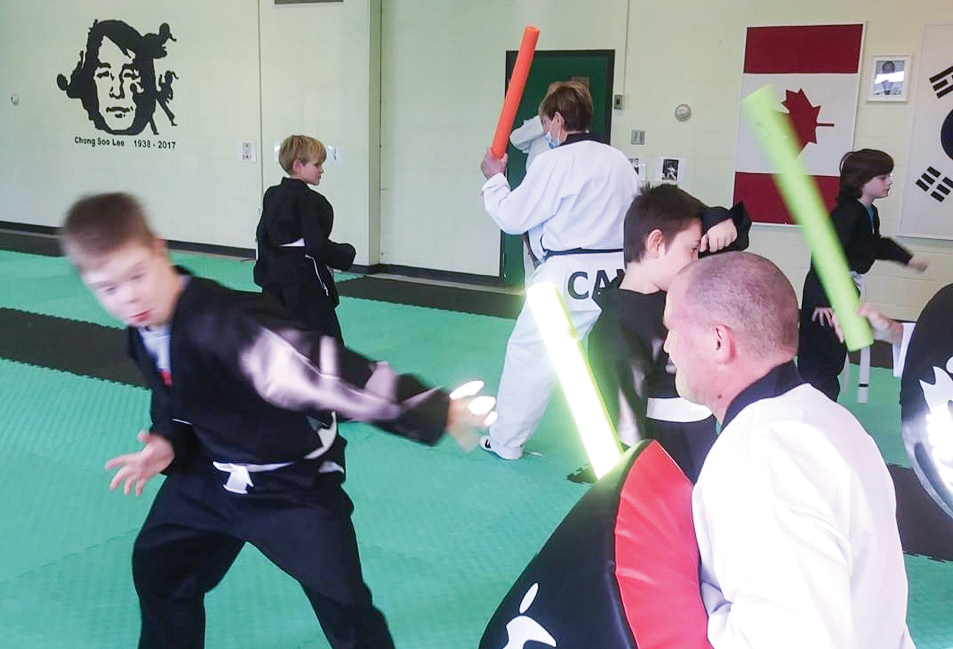
Taekwondo, by its nature, is a combat sport involving punching and kicking techniques.
But what if you could teach it without the combat?
That’s what the Island Martial Arts Centre in Cape Breton, part of the Maritime Taekwondo Union of schools, decided to do three years ago as a way to include youth with special needs.
“We would have kids come into the class who have Down Syndrome, autism or other needs, and they didn’t seem to be lasting very long in the program,” said Rick Fraser, instructor at the Island Martial Arts Centre. “It’s quite structured and takes a lot of concentration and effort, and so it really wasn’t geared to that part of our community to be involved completely.
“Some could make it. We have one gentleman, he’s about 18 now, and he just got his black belt and he has autism, but most people who come from that community do have difficulty being in that structure.”
And so, the decision was made to modify the program to take much of the combat element out, focusing on other elements of the sport, such as self-defence, anaerobic and aerobic exercise, and relaxation.
“With what we teach, there is a lot of fighting involved and a lot of fighting for testing,” said Fraser. “And a lot of the kids from the special needs community, they can’t engage in that kind of an activity. I find that they have so much empathy for everybody else, they’ll say, ‘Oh, why do I have to hit that person? I don’t want to hit that person.’ It just doesn’t work with the traditional form of taekwondo we teach.”
Fraser said that special needs kids wear the same uniforms and practice the same forms and techniques that others do, with the level of physicality limited to board breaking, commonly used for testing, training and martial arts demonstrations.
A typical session will involve warm-ups, drills to practice forms, blocks and strikes, then typically a 10-minute break where kids would play some games, followed by more training with participants broken up into groups based on skill, and some board breaking.
“The kids really like that,” Fraser said. “We use the rebreakable boards, which are pretty easy to break.
“It’s usually one hour a week, so that gives them a little bit of fitness, they learn a little bit of taekwondo and have a bit of fun while doing it.”
Fraser admits that even with the modifications, there are some participants who don’t stick with it. But for those who do, the results can be gratifying.
“We have one young fellow who’s with us right now, a Down Syndrome child, and he can do a dropkick or a crescent kick better than almost any black belt,” said Fraser.
Fraser says he has a group of six black belts who volunteer as instructors, allowing for as much one-on-one training as possible.
“You do have challenges,” said Fraser. “And what you have to do is work with the challenges and modify your behaviour with them, not their behaviour with you. That’s the key.
“I don’t know if we’ll get into offering two or three classes a week, we just don’t have the time or the space available. Working with special needs kids requires a lot of attention and we’ve got a pretty good handle on that now with what we offer, so I see us being able to do that for a long time.”