


Hurricane Fiona caused plenty of damage when it landed in Nova Scotia last September.
But it also led to a tremendous opportunity.
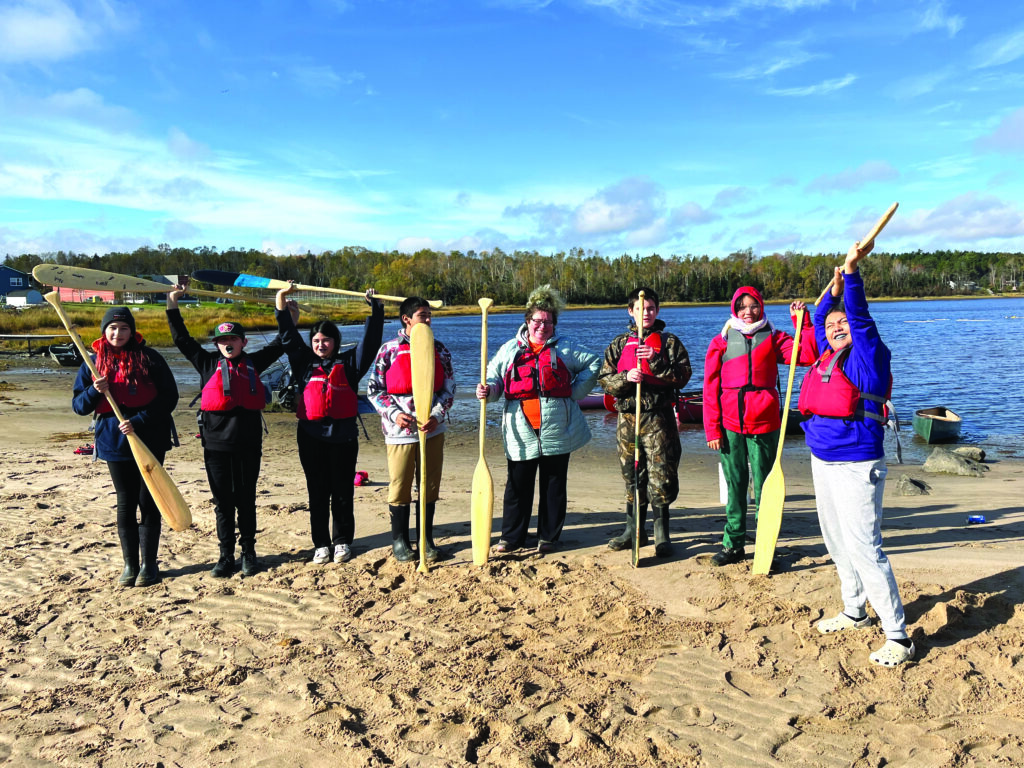
Students from Pictou Landing First Nation, in conjunction with the Pictou County Forest School, took pine trees uprooted during the storm and designed, shaped and decorated their own canoe paddles.
“It was a great way to take the damage that was caused by Fiona and use it for a meaningful purpose,” said Scott Ross, founder and instructor at Pictou County Forest School. “The first group that came, we actually took the logs over to a local sawmill and have the students watch the milling process, just so they could understand that and know where these things come from. You realize just how important resources are and how much work goes into something like this.”
Students also learned about the history of the birch canoe and its significance to the Mi’kmaq people, and made birch bark journals bound with spruce root. The forest school’s apple press was used to make cider and a spaghetti feast was cooked in the forest.
Other activities included paddling on the Big Caribou River that borders the forest school land, teaching students basic strokes, and regular hikes to a hammock village for quiet rest and reflection. For the final week, forest school staff travelled to the First Nation school with a fleet of canoes, and put in at Sitmu’k (Moodie Cove), located right behind their school. Students were presented their finished paddles and they used them for the first time in the cove, playing canoe games like tag and races. The group also painted place signs in Mi’kmaq for a tree in our forest to show distances to areas in Mi’kma’ki.
“It’s a different way of learning,” said Ross. “This was just a way of understanding that there’s just as much value in learning in an outdoor setting as there is in a classroom.”
And judging by the feedback received, students are eager to learn more. The school was founded in 2021 and started as a two-week pilot project during the summer. Ross, who was teaching in Pictou County at that time, did an initial outreach on social media and within 24 hours of launch, his enrolment had been filled, with 70 more students on a waiting list.
The program has since evolved into a five-week nature immersion session with students coming one day per week and connects what students learn with what is taught in the Nova Scotia curriculum. Ross said 1,500 students took part during the last school year.
“We send surveys out every session, and parents have told us that their kids are more productive the rest of the week when they spend a day with us,” said Ross. “They’re more driven, they’re more focused and it’s helped their academic performance.
“The comments we got from the students were universally positive. You’d hear some say they wish school could be like this every day.”
Ross says his focus going forward will be to introduce programs like this to other schools and to be more accessible, and has reached out to SchoolsPlus and to African Nova Scotian communities to gauge interest.
“I enjoyed teaching in schools, but what I really think a program like this offers a huge chance for personal growth,” said Ross. “It helps kids feel successful, especially those who may struggle with traditional subject matter.”